Nobody's Built the App Store for Robots Yet. So I Did. In a Day.
What the humanoid robot revolution reminded me about 2008, the wild west of apps, and why AI just collapsed the distance between idea and reality.
It started with carrot juice and a Substack article.
I was reading Peter Diamandis's recap of the AI Agent Abundance Summit (Day 2), where he brought three humanoid robot CEOs on stage to talk about what's shipping this year. Not concept renders. Not lab demos. Actual robots. Going into actual homes. In 2026.
And one line stopped me cold.
He called it a Cambrian explosion in humanoid robotics. Three wildly different companies. Three different bets on the future of labor. All of them raising hundreds of millions, all of them deploying now.
I finished my carrot juice(don't judge... it's healthy) and thought: somebody has to design what comes after the hardware.
That somebody ended up being me. By dinner.
I've Felt This Before
Cast your mind back to 2008.
Apple launches the App Store. And look... nobody knew what they were doing. I mean nobody. There were fart apps sitting right next to apps that would eventually become billion dollar companies. There were flashlight apps, there were tip calculators, there were games that made zero sense. It was absolute chaos.
And it was glorious.
Because out of that chaos, that beautiful, messy, nobody-has-any-rules wild west, came Uber. Instagram. Airbnb. Shazam. Apps that didn't just change industries, they invented new ones. Apps that redefined what it meant to have a computer in your pocket. (I will admit that my first app contribution was the iSlap... an app that when you held your phone and waved it around it made various slapping and punching sounds... It wasn't successful)
Nobody sat down in 2007 and said "I'm going to design the future of transportation." They just made something. They threw it at the wall. The wall turned out to be the entire global economy.
I was a mid level designer back then. I remember the feeling. That electric, slightly terrifying sense that the rules hadn't been written yet... and whoever wrote them first was going to matter.
I felt that same feeling reading Peter's article.
So Who's Designing the App Store for Robots?
Here's the thing nobody's talking about yet.
Everyone is obsessed with the hardware. The robots themselves, how they move, how they lift, how they don't accidentally clothesline your kid when they walk through the kitchen. And yes, that stuff matters. Safety is the moat, as the article put it.
But here's what I kept thinking: the iPhone wasn't just a phone. It was a platform.
The thing that made the iPhone revolutionary wasn't the hardware, it was what developers could BUILD on top of it. The App Store created an entire economy. Millions of developers. Billions of downloads. Trillions of dollars in value. All because Apple said "here's a device, now go build the future."
NEO ships this year. Digit is already in Amazon warehouses. The hardware is coming whether we're ready or not.
So who's designing the software layer? Who's building the App Store for your robot?
I looked around. Nobody had done it yet.
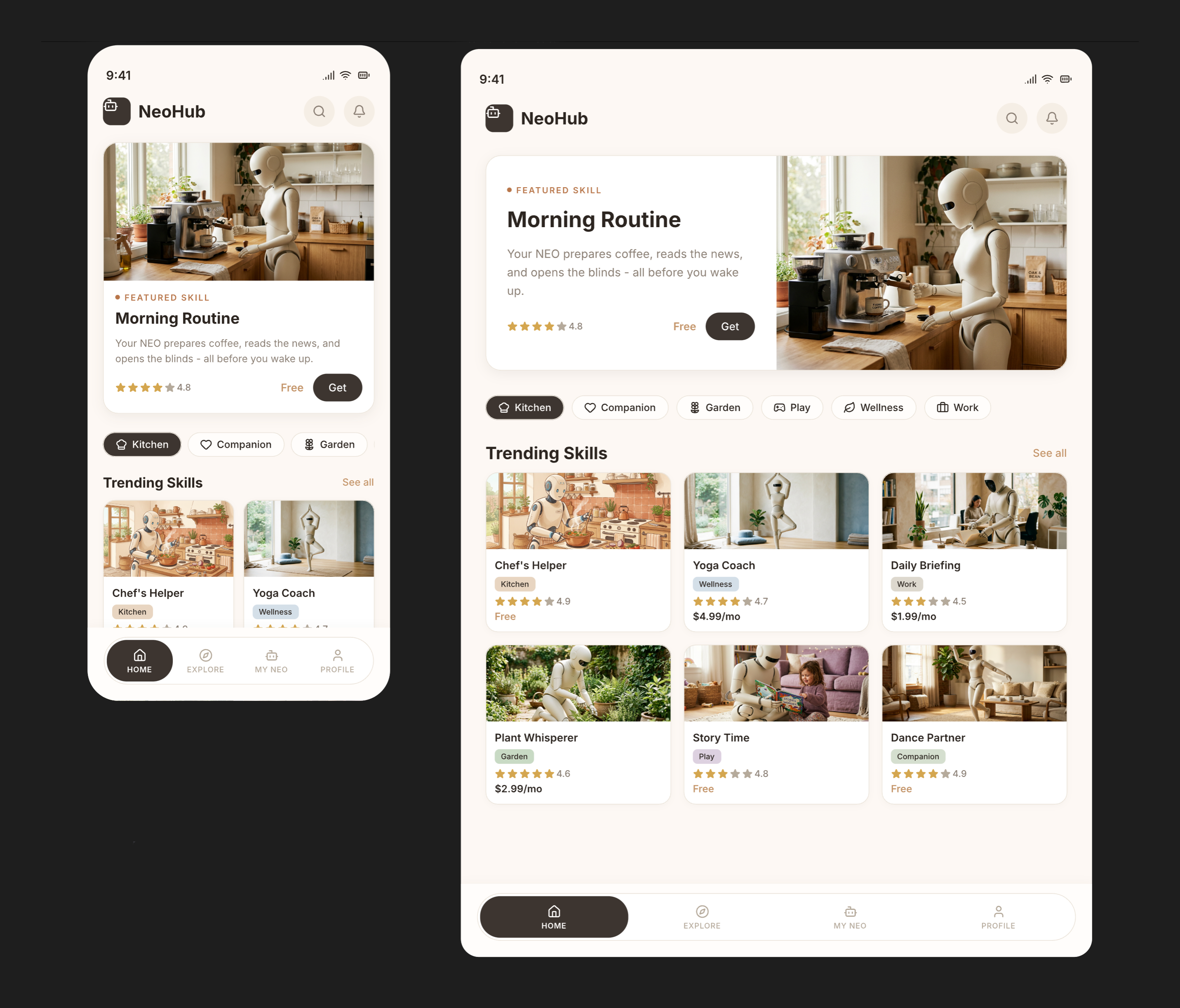
So I spent an afternoon and built a concept. I called it NeoHub.
What One Afternoon Looks Like in 2026
Here's where I have to be honest with you about something.
The old version of this story goes like this: designer has big idea, designer spends three weeks in Figma, designer presents to stakeholders, stakeholders request changes, designer cries quietly, repeat for six months, something ships that's 40% of the original vision.
The 2026 version? Completely different.
I used Pencil — an AI design tool — to generate screen concepts by describing what I wanted in plain language. I used Claude Code to turn those designs into a real, working, clickable prototype. I used Vercel to deploy it live to the internet.
Ten screens. Full navigation. Real images. Clickable interactions. Live URL.
One afternoon.
And I want to be clear — this isn't a flex. I'm not telling you this to brag about my workflow. I'm telling you because the distance between idea and reality just collapsed, and if you're a designer and you haven't felt that yet, you need to feel it. Soon.
The concept itself? An app store for NEO — the home humanoid robot by 1X Technologies. Skills you can install on your robot, just like apps on your phone. A cooking subscription that trains on Michelin star chefs. A gardening guide. A D&D companion that doubles as a game master. (And yes, it shows you contextually relevant eBay listings for rare Magic cards when you lose a game. Because of course it does.)
Different pricing models. Ratings and reviews. A developer portal for people who want to build skills. A permissions system for when your robot wants access to your kitchen sensors and grocery list.
The whole ecosystem. In one afternoon.
The State of AI-Powered Design in 2026
Let me zoom out for a second because I think there's a bigger point here worth making.
A lot of designers are scared right now. I get it. The tools are moving fast, the job market is weird, and every other LinkedIn post is either "AI will replace designers" or "AI can't replace human creativity" — and both camps are kind of missing the point.
Here's what I actually believe after 25 years in this industry:
AI doesn't replace taste. It removes lag.
The thing that separates a great designer from an average one was never the ability to push pixels faster. It was always vision — the ability to look at a cultural moment and say this is what's coming, and here's what it should feel like. The ability to walk into a room and see the problem nobody else has named yet.
AI doesn't have that. AI can't read a Substack article at breakfast and feel that electric "oh something big is happening here" sensation in your chest. AI can't draw on 18 years of building products, on remembering what 2008 felt like, on knowing the difference between a trend and a tectonic shift.
What AI CAN do is take that vision and execute it at a speed that used to be impossible for one person.
That's the shift. That's what 2026 looks like for designers who embrace it.
The dangerous designers right now aren't the ones using AI — they're the ones treating AI like a threat instead of a time machine. Because while they're debating whether to try Pencil, someone else already shipped the concept, deployed the prototype, and texted Peter Diamandis the link.
(More on that in a minute.)
The new skill isn't Figma proficiency or component libraries or even prompt engineering. The new skill is thinking at the speed of the tools. Having enough vision and taste and experience to know WHAT to build — and then using AI to build it before the moment passes.
The moment always passes. 2008 taught me that too.
What's Next (And a Note to Some People I Don't Know Yet)
NeoHub is a concept. A provocation. A "what if."
But I genuinely believe the robot app store is coming. Maybe not called NeoHub. Maybe not built by me. But the platform layer for humanoid robots is going to be one of the most interesting design and business problems of the next decade — and whoever solves it is going to matter in the same way the early App Store developers mattered.
Think about what that economy looks like. Developers building robot skills the same way they built iPhone apps. Subscription revenue for cooking skills that update as new techniques emerge. Free-with-ads models for companion skills that surface relevant products mid-game. ("Looks like I win this round... there's a 1st Edition Charizard on eBay. Current bid: $47.") Enterprise tiers for businesses deploying robot fleets with custom skill packages.
It's all there. The business model writes itself.
And if you think the wild west of 2008 was something — just wait until there are a million developers building skills for robots living in people's homes. We haven't even begun to imagine what that looks like yet.
Which is kind of the point.
The rules haven't been written. Whoever writes them first is going to matter.
P.S. I already have my NEO on pre-order, so this isn't just a thought experiment for me. It's a product I'm genuinely going to use. And if the team at 1X ever wants to talk about what the skill ecosystem could look like... you know where to find me. Free Figma files included.
And Peter, if you're reading this hey. It's Al from Create Ape. We worked on Fountain Life together. Told you I was paying attention. 😄
Recent in blog
The Last Generation That Remembers

If Healthcare Apps Were Designed Like Netflix, What Would Change?