The Last Generation That Remembers
An ode to the world before the internet, the people who made it beautiful, and the ordinary moments we never knew we’d miss.
I miss being bored.
There. I said it. And before someone accuses me of becoming that middle-aged guy who complains about kids staring at their phones while reminiscing about drinking water from a garden hose, hear me out.
I grew up in the 1980s and 1990s. A strange, wonderful little window in human history when technology was advancing at an absolutely ridiculous pace, but hadn’t yet consumed every waking moment of our lives.
We had computers, but they weren’t everywhere. We had video games, but they didn’t follow us into the bathroom. We had television, but when your favorite show ended, that was it. You waited until next week. No streaming, no binge-watching, no algorithm immediately serving up seventeen other things you might enjoy.
And if you wanted to know something? Well, sometimes you just didn’t. Imagine that.
There was something magical about living in a world where information wasn’t immediately available, where entertainment required a little effort, and where the future still felt genuinely mysterious.
And now, at 44 years old, having spent more than two decades helping build the digital world that replaced it, I find myself wondering whether we lost something along the way.
Not something technological.
Something human.
When Saturday Mornings Lasted Forever
In 1992, I was ten years old and living in Walnut Creek, California. My family moved constantly because of my father’s business. New houses, new apartments, new schools. Sometimes we’d move after a year, sometimes even sooner. But for a little while, Walnut Creek was home.
Saturday mornings were sacred. I’d wake up early, usually before anyone else, and play Nintendo while the house was still quiet. There was something wonderful about those mornings. No responsibilities, no expectations, nobody asking you to do anything. Just a little boy, a controller, and perhaps a game of Tecmo Football.
Eventually, I’d wander into the kitchen and pour myself a bowl of Cinnamon Toast Crunch. And here’s something that might sound positively prehistoric to younger readers. I would read the back of the cereal box. Seriously. Sometimes I’d grab an Encyclopedia Brown book or a Peanuts comic. Other times, I’d just sit there eating cereal and staring at whatever marketing nonsense General Mills had decided to print that month.
Because what the hell else was I going to do? There was no phone to check. No social media. No notifications. No endless feed of content demanding my attention.
Eventually, my younger brother Nick would wake up, and we’d watch cartoons. X-Men was a favorite, but I was particularly obsessed with Exosquad. I loved that show so much that I collected the action figures. In fact, decades later, I hunted some of them down on eBay, and they now occupy a prominent place on the bookshelf in my office. Apparently, some things never change.
But by eleven o’clock, television was usually over. It was time to go outside. And outside was an entirely different universe.
Walnut Creek had these wonderful trails connecting neighborhoods, parks, and open spaces. There were creeks and runoff channels where my friends and I would catch crawdads. Naturally, being ten-year-old boys with an extraordinary capacity for stupidity, we decided the crawdads should fight each other. We’d cheer them on like characters in Street Fighter II. Unfortunately, the crawdads were considerably less enthusiastic about organized combat than we were, and usually wandered back into the creek. Probably for the best.
We rode our bikes everywhere. Sometimes we’d head over to Heather Farm Park and race down hills. Other times we’d find ourselves at a nearby Christian high school, playing tackle football on the field. I was a running back, and my friends nicknamed me “Kid Kick Ass.” Yes, really. And yes, I’m putting that in writing at 44 years old.
We weren’t exactly angels, either. Once, we discovered a pallet of soft drinks near the school’s maintenance area and proceeded to help ourselves. Then, because apparently drinking free soda wasn’t entertaining enough, we started throwing cans into the air to watch them explode against the pavement. Another time, I climbed one of the enormous pine trees surrounding the school. I must have been three stories high. Looking back, the fact that I survived childhood is something of a miracle.
And here’s the funny part. As a father of three boys, I would absolutely lose my mind if I discovered my children doing half the things I did. But that’s the contradiction, isn’t it? We look back fondly on the freedom we had, while simultaneously being terrified of giving our own children that same freedom.
I’m not suggesting we should return to an era of completely unsupervised childhood adventures. Some of the things we did were genuinely dangerous. But I do wonder whether we’ve lost something in the process of making childhood safer, more structured, and more connected. Because back then, a bicycle and a few friends were enough to turn an ordinary Saturday into an adventure. And somehow, we never seemed to run out of things to do.
The Beautiful Art of Not Knowing
One of my favorite childhood memories involves a joystick. Yes, a joystick. I bought a Microsoft SideWinder that came bundled with several PC games, including Wing Commander II, Ultima VIII: Pagan, Syndicate Plus, and Strike Commander.
Now, here’s the important part. I didn’t know what most of these games were. There was no YouTube review to watch. No Metacritic score to consult. No Reddit community explaining which game was worth my time. I just had a handful of games, a computer, and an enormous amount of curiosity.
So I installed Ultima VIII. And my God. I had absolutely no idea what I was doing. I found myself in this strange, unfamiliar fantasy world, surrounded by characters, locations, and systems I didn’t understand. And it was incredible.
At some point, I discovered a house in a wealthy part of a city. It belonged to somebody else. Naturally, I decided it was mine. I moved in and spent hours decorating the place. I’m not kidding. Long before The Sims became a cultural phenomenon, I was playing medieval interior decorator in a game that probably had very different intentions for its players.
But that was the magic. I wasn’t following a walkthrough or optimizing my character build. I wasn’t trying to experience the game the way somebody else thought I should. I was discovering it.
Another Christmas, my grandmother Debbie bought me two PC games: SimCity 2000 and Lords of the Realm II. That second game changed my life in ways she probably never imagined. It introduced me to Sierra, beginning a love affair with games that continues to this day. Lords of Magic, Caesar, Quest for Glory, Arcanum, and countless others would eventually occupy an enormous amount of my childhood and adult imagination.
But what I remember most about Lords of the Realm II wasn’t winning. It was deliberately not winning. I’d choose a little county tucked away in the mountains of England or France, build my castles, raise my armies, and imagine the lives of the people living there.
The farmers. The soldiers. The families in little hamlets surrounding the main town. I didn’t care what the other computer-controlled kingdoms were doing. I had my own little world. And I was perfectly happy living inside it. I never told anyone about these imaginary stories. They were mine.
Looking back, I think there’s something important about that. The games provided the foundation, but my imagination did much of the heavy lifting. And perhaps having fewer games encouraged me to explore the ones I owned more deeply. Because when you couldn’t buy something new every five minutes, you learned to appreciate what you already had.
When Getting Something Was Half the Adventure
I remember the first time I saw Street Fighter II running on a Super Nintendo. My friends and I had spent countless hours playing it at the arcade cabinet inside Round Table Pizza near our house. And then suddenly, there it was. Street Fighter II. In somebody’s living room. Are you kidding me? The idea that you could play something like that at home was absolutely mind-blowing.
Of course, I didn’t get a Super Nintendo immediately. I had to wait, beg, save, and hope that a birthday or Christmas might finally deliver the goods. That’s how things worked. And sometimes, the waiting became part of the experience.
I remember buying Super Mario Bros. 3 during a road trip with my mother from the San Francisco area down to Palm Desert, where my grandmother lived. The problem? I didn’t have my Nintendo with me. So I spent the drive reading the instruction manual. Over and over again. I’d study the pictures, imagine the levels, and fantasize about what it would be like when I finally got home and could play. Today, that sounds almost absurd. But I loved every minute of it.
And it wasn’t just video games. I remember buying the LEGO Pirates Lagoon Lock-Up set and spending afternoons playing with it near the pool at my grandmother’s condo in Rancho Mirage. The sunshine, the swimming pool, the smell of the desert, the little plastic pirates. Those memories are so deeply embedded in me that I now own three mint-condition Lagoon Lock-Up sets.
Three.
My wife is a very patient woman. But here’s the thing. Those LEGO sets aren’t really about LEGO. They’re little physical connections to a time and place I can never visit again. And I suspect that’s why so many people my age collect the toys, games, and artifacts of our childhood. We’re not necessarily trying to reclaim the objects. We’re trying to reclaim the feeling.
The Friday Nights We Thought Would Never End
If you grew up in the 1990s, you probably remember the sacred ritual of Friday night. School was over. If you were particularly lucky, it was a half day. You and your friends would immediately begin negotiating with your parents to arrange a sleepover. Somehow, through a combination of persistence, charm, and shameless begging, you’d get permission.
And if the stars aligned, you’d manage to squeeze twenty dollars out of somebody. Twenty dollars! That was practically a venture capital round for a group of twelve-year-olds.
The budget was simple. A large Domino’s pizza special for $14.99. A two-liter bottle of soda for ninety-nine cents. And whatever remained went toward renting a movie or video game at Blockbuster. If someone managed to scrounge up a few extra bucks, we’d get both. Maybe the latest Schwarzenegger action movie. Maybe Saturday Night Slam Masters for the Super Nintendo.
Then we’d head home, eat pizza, drink soda, play games, laugh, argue, and stay up far later than we were supposed to. And those nights were perfect. Not because anything extraordinary happened. But because, at that age, they felt infinite.
There would always be another Friday. Another sleepover. Another trip to Blockbuster. Another night when the biggest problem in the world was deciding who got the controller next. Except there wasn’t.
At some point, there was a last time. A final Friday night when we ordered pizza, rented a movie, and stayed up playing games together. And none of us knew it. Nobody announced that we were experiencing the end of something. There was no ceremony. No farewell. We simply grew up. And one day, those nights became memories.
That’s something I’ve been thinking about more and more as I get older. How many ordinary moments in our lives turn out to be the last time we ever do something? The last time you pick up your little boy before he becomes too big to carry. The last time your father is young enough to play tennis with you. The last family gathering where everyone you love is sitting around the same table.
We rarely recognize these moments while they’re happening. And perhaps that’s what makes them so precious.
The World Before Everything Was Available
I don’t want to romanticize the past too much. The 1990s weren’t some magical utopia. We had problems. Plenty of them. Information was harder to access. Technology was less reliable. Finding things could be frustrating. And if you missed an episode of your favorite television show, you might genuinely have to wait months to see it again. But there was something wonderful about the limitations.
You couldn’t watch every movie whenever you wanted. You couldn’t buy every game instantly. You couldn’t listen to every song ever recorded. And you certainly couldn’t pull a device out of your pocket and immediately answer virtually any question that popped into your head. Sometimes you simply had to wait. Sometimes you had to wonder. Sometimes you had to discover things for yourself. And sometimes you had to be bored.
Today, I can open Steam and access a library of games that would have made my twelve-year-old head explode. I can watch practically anything I want, whenever I want. I can listen to millions of songs. I can order something from Amazon and have it delivered to my doorstep tomorrow. And yet, something strange has happened. We have more entertainment than any generation in human history, but we often seem less satisfied by it.
Look at the phenomenon of the Steam backlog. People own hundreds, sometimes thousands, of games they’ve never played. Games that were supposed to provide entertainment have somehow become another item on an ever-growing to-do list.
Netflix isn’t much different. How many times have you spent forty minutes scrolling through movies, unable to decide what to watch, before giving up entirely? We’ve become so obsessed with having access to everything that we’ve forgotten how to appreciate something.
And I don’t think technology alone is responsible. Our entire digital economy increasingly revolves around capturing attention, maximizing engagement, and encouraging consumption. More content. More recommendations. More notifications. More things you might like. More, more, more.
There’s a fundamental difference between technology that enriches an experience and technology that constantly interrupts it. And somewhere along the way, I think we stopped paying attention to that distinction.
The Strange Little Address That Changed My Life
In 1993, I remember seeing something unusual on a billboard in San Francisco. It was an advertisement for a bank. And at the bottom was a strange string of characters. A website address. A URL. I had no idea what the hell it was.
Think about that for a moment. Today, website addresses are so commonplace that we barely notice them. But I remember seeing one for the first time. I was looking at something that would fundamentally change civilization, and I didn’t even know what I was looking at.
A few years later, I would discover AOL on my grandmother’s computer in Palm Desert. And like any intellectually curious adolescent presented with a revolutionary global communications network, I immediately found a chat room where I could pretend to be older and flirt with women. Clearly, the future of humanity was in excellent hands.
But beneath the ridiculous teenage antics was something extraordinary. For the first time, I could communicate with people I had never met, in places I had never visited, through a computer. The world was suddenly becoming connected. And I was fascinated.
What I couldn’t possibly have understood back then was how profoundly that technology would shape my life. I eventually built an entire career around the internet. For more than twenty-three years, I’ve worked in digital design, user experience, product strategy, and technology. I’ve built businesses, led teams, and helped companies create digital products used by people around the world. None of that would have existed without the internet.
Which makes my nostalgia for the world before it somewhat ironic. I’m mourning a world that disappeared because of a technological revolution that also gave me much of what I have today. And I don’t regret that revolution. Not for a second. But I do wonder whether, in our enthusiasm to build a more connected world, we fully appreciated what we were leaving behind.
The Little Machine I Would Happily Destroy
When Steve Jobs introduced the first iPhone in 2007, I wasn’t impressed. In fact, I thought it was stupid. I went to an Apple Store, tried it, and couldn’t stand the touchscreen. Apparently, my ability to predict technological trends has certain limitations.
Nearly twenty years later, smartphones have become indispensable. And I absolutely despise what they’ve done to so much of our daily lives.
Now, before someone points out the obvious irony, I’m fully aware of it. As I write this, I’m taking a break from work on a Monday afternoon, lying in bed, dictating my thoughts to an artificial intelligence through my smartphone. The technology allows me to work remotely, communicate instantly, and accomplish things that would have been unimaginable when I was a kid. It’s incredible. It’s also, in my opinion, become one of the most intrusive technologies humanity has ever embraced.
We’re constantly connected. Constantly consuming. Constantly interrupted. News, notifications, social media, advertising, shopping, entertainment, and increasingly sophisticated algorithms competing for every spare second of our attention. We carry the entire world in our pockets. And sometimes I wonder whether that means we’ve forgotten how to be present in the little part of the world we’re actually standing in.
I used to go to the beach with a Walkman. I’d listen to Lenny Kravitz or Limp Bizkit, rewind the same songs over and over, and spend the afternoon enjoying the ocean. There wasn’t an endless feed waiting for me. No breaking news. No notifications. No sudden temptation to order a new television because an advertisement appeared between two videos. Just the beach, the music, and whatever happened to be going on around me.
Was that objectively better? Not necessarily. But it was different. And I miss it.
I’ve often joked that if I ever sold my company and never had to work again, I’d hold a ceremonial destruction of my smartphone. Something elaborate. Perhaps a trebuchet. Then I’d buy myself a rotary telephone. Maybe a cordless phone if I was feeling particularly adventurous. And a really good answering machine. Because apparently my ultimate vision of financial freedom is becoming technologically indistinguishable from somebody’s grandfather in 1987.
And Now Comes Artificial Intelligence
Here’s where things get particularly interesting. I grew up during the transition from the analog world to the digital one. I watched the internet transform society. I watched smartphones fundamentally change how we interact with information, entertainment, businesses, and one another. And now, at 44 years old, I’m witnessing the beginning of another technological revolution. Artificial intelligence.
Except this one feels different. The pace of change is extraordinary. Five years ago, the idea of having a sophisticated conversation with an AI about childhood memories, philosophy, and the human condition would have sounded like something out of a science fiction novel. Today, it’s something I can do while lying in bed on a Monday afternoon. AI can already help us write software, generate images, create videos, analyze complex information, and automate work that once required teams of people. And we’re still early.
What will the world look like in 2030? Hell, what will it look like in 2028? I genuinely don’t know. And for someone who has spent his entire professional life working with technology, that’s both exhilarating and unsettling.
I sometimes wonder whether my children will look back on 2026 the same way I look back on 1992. Maybe they’ll remember a world where people still drove their own cars, wrote their own emails, created their own art, and occasionally had to figure something out without asking an artificial intelligence. Maybe they’ll laugh at how primitive it all was. Or maybe they’ll miss it. Maybe they’ll remember a time when the world still moved slowly enough that you could occasionally understand what the hell was happening.
Because if history has taught me anything, it’s that we rarely understand the full consequences of technological change while we’re living through it. The internet gave us extraordinary opportunities. It also changed our relationship with privacy, attention, community, and information in ways we never fully anticipated. Smartphones gave us unprecedented convenience. They also made it increasingly difficult to disconnect. And now we’re building systems that may fundamentally change what it means to work, create, learn, and perhaps even form relationships.
Will it make our lives better? God, I hope so. I really do.
Maybe AI will free us from tedious work and give us more time with the people we love. Maybe it’ll help us cure diseases, solve problems that have plagued humanity for centuries, and unlock possibilities we can barely imagine. Or maybe we’ll use all that newfound power to consume even more, surrender more of our attention, and become increasingly disconnected from the world around us. I don’t know which future awaits us. Probably some complicated combination of both.
But I do know one thing. Technological progress and human happiness aren’t necessarily the same thing. And if we’re not careful, we may become extraordinarily good at creating things without ever stopping to ask whether those things are making our lives better.
A Day I Would Give Anything to Experience Again
When I was thirteen, my family lived in an apartment on Spalding Avenue in Beverly Hills. I remember one particular Saturday. My parents took my brother, my sisters, and me to Santa Monica Beach. We spent almost the entire day there.
I went boogie boarding. Built a sandcastle. Ate a sandwich and sour cream and onion Pringles. I remember carrying our things across the sand, which was so incredibly hot that I’d occasionally have to stand on my boogie board just to cool my feet. Nothing extraordinary. Just a beautiful day at the beach.
When we got home, I showered, and that evening we went to Mulberry’s Pizza in Beverly Hills. My grandfather, whom we called Nono, was there. So was Debbie, and some of my aunts and their families. The restaurant was loud, rambunctious, and full of people I loved.
And the pizza? Good God. I could eat slice after slice, wash it all down with Coca-Cola, and somehow remain a skinny thirteen-year-old. Youth really is wasted on the young.
After dinner, my brother and I went across the street to Thrifty’s with Debbie and my sisters. We got mint chocolate chip ice cream, which I remember costing something like thirty-nine cents a scoop. And while we were there, Nick and I flipped through gaming magazines with a notepad, copying down passwords and codes for games we were thinking about renting from Blockbuster. Then we went home and played video games until bedtime.
That was it.
That was the day.
And more than thirty years later, I remember it with extraordinary clarity. The hot sand. The Pringles. The pizza. The ice cream. The sound of my family laughing around the table.
I’ve thought about that day many times. And I’ve realized something. It wasn’t special because we did anything extraordinary. It was special because everyone was there. My parents were younger. My grandparents were there. My siblings and I were children. And the world still felt like it had an infinite number of Saturdays waiting for us.
I remember other days like that, too. Watching Michael Jordan win NBA championships at my grandfather’s house in the Beverly Hills hills while Debbie made hamburgers and the adults talked and laughed. Playing tennis with my dad and my brother. Those are the memories that come back to me now.
Not the expensive things. Not the accomplishments. Not the milestones that seemed so important at the time. Just ordinary days with people I love.
And if I could go back and experience one of them again? I would. In a heartbeat.
Not because my life today isn’t wonderful. It is. I have a wife I love, three incredible boys, and a life that younger me couldn’t possibly have imagined.
But I miss my dad being young enough to play tennis with us. I miss those family dinners. I miss being a little boy who didn’t yet understand that time was passing. And I miss the feeling that those days would last forever.
The Little Boy Never Really Left
There’s something I should probably confess. I still play with LEGO. And I don’t mean that I occasionally help my children build something. I mean that I have a LEGO airplane my father bought me when I was five years old. It’s still assembled. And every now and then, late at night when everyone else is asleep, I’ll take it out and fly it around my bedroom. Complete with jet noises.
Yes. A 44-year-old father of three, business owner, and supposedly responsible adult making airplane noises in his bedroom. I have absolutely no shame about this.
And you know what? I still play imaginary games with my boys. They’re eleven, fourteen, and eighteen now, so convincing them to participate occasionally requires some negotiation. But every so often, I manage to get all three of them together, and suddenly we’re battling orcs, exploring imaginary worlds, or sitting around a table playing Dungeons & Dragons. Four guys, ranging from eleven to forty-four, pretending to fight monsters that don’t exist.
And it’s wonderful. Because for a little while, the rest of the world disappears. There are no algorithms. No notifications. No endless stream of content competing for our attention. Just a father and his sons, laughing and imagining things together.
And I realize that perhaps the world I grew up in isn’t entirely gone. Maybe parts of it are still here. Not in the technology. Not in the stores or the toys or the old computer games.
But in the experiences we choose to create. In the stories we tell. In the people we love. In our willingness to occasionally put everything else aside and simply enjoy being alive.
Enjoy It, My Love
For years, whenever I dropped my boys off at school, I’d tell them the same thing. “Enjoy it. Enjoy it, my love.” And sometimes they’d look at me like I was crazy. Because to them, it was just another school day. Another morning of classes, homework, and responsibilities.
They couldn’t wait for the weekend. Couldn’t wait for summer. Couldn’t wait to be older. And I understood. Because I was exactly the same way. But what I wanted them to understand was something I couldn’t possibly have understood at their age.
One day, they’re going to miss this. Not necessarily the homework. Not the tests. Not waking up early. But the little things surrounding all of it. The drive to school. The conversations with their brothers. The friends they see every day. The ordinary routines that seem so insignificant because they’ve never known anything different.
One day, those routines will end. And they won’t necessarily know when they’re experiencing them for the last time. Just like I didn’t know that one Friday night at Blockbuster would be the last. Or that one afternoon playing tennis with my dad would eventually become a memory I’d give anything to revisit. Or that a noisy family dinner at Mulberry’s Pizza would remain so vividly etched in my mind more than thirty years later.
And that’s what I would tell my twelve-year-old self if I could sit beside him for five minutes. Not how to make money. Not how to build a business. Not which technologies to invest in.
I’d tell him to enjoy his Saturday. To ride his bike. To play with his brother. To hug his grandparents. To appreciate the fact that his dad can still run around a tennis court with him. And to stop wishing so desperately for tomorrow. Because tomorrow is coming whether he wants it to or not. And someday, he’ll look back on the very moments he’s rushing through and wish he could experience them just one more time.
I don’t know what artificial intelligence will do to our world. I don’t know what childhood will look like twenty years from now, or what incredible technologies my children and grandchildren will grow up taking for granted. I hope their world is better than mine. I hope they experience things I couldn’t possibly have imagined. And I hope, somewhere in all that progress, we remember to preserve the things that make being human so extraordinary.
The wonder. The curiosity. The imagination. The anticipation. The freedom to spend an afternoon doing absolutely nothing productive. And most importantly, the people we get to share those afternoons with.
Because thirty years from now, today will be somebody’s 1992. The ordinary moments we’re living right now will become the memories we wish we could revisit.
So enjoy it. Enjoy it, my love.
I know it seems boring sometimes. I know it seems tedious. I know there are days when you wish you could just skip ahead to whatever comes next.
But I promise you.
I promise you.
I promise you.
You’ll miss this one day so badly it’ll make your knees buckle.
Enjoy it. Make the memories. Cherish them.
Because those are the things you can actually take with you.
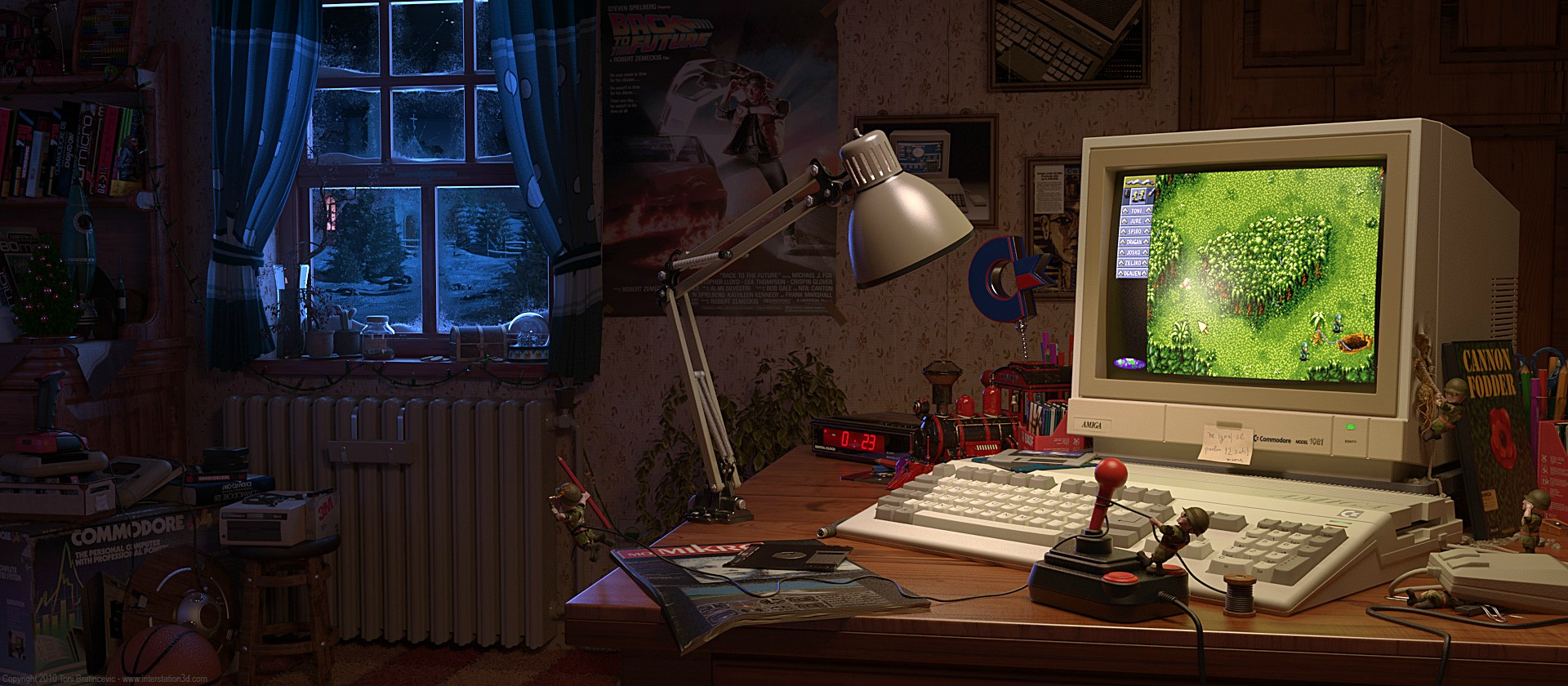
Header image: Toni Bratincevic, interstation3d.com.
Recent in blog
Nobody's Built the App Store for Robots Yet. So I Did. In a Day.

If Healthcare Apps Were Designed Like Netflix, What Would Change?